








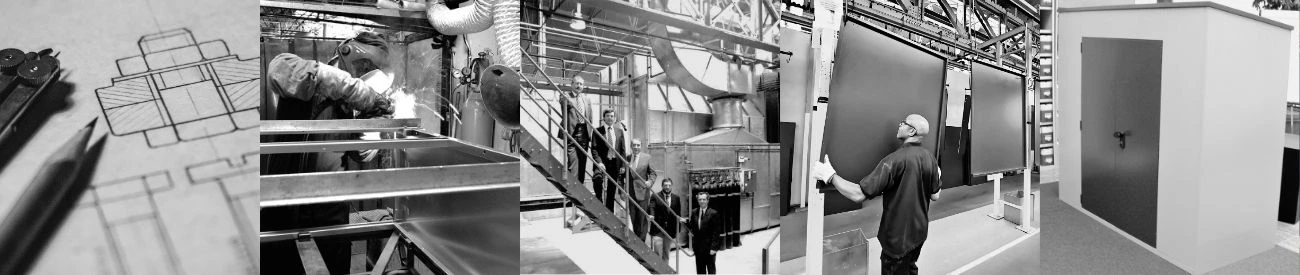
Building Asgard: 20 Years of Product Development, Marketing & Manufacturing
By Andy Heath
When people look at Asgard today, they see a successful British manufacturing company producing secure steel storage products for customers across the UK. What they don't see is the journey that got us here.
Over all these years, I've had the privilege of being involved in almost every aspect of the business. Product development, design, marketing, ecommerce, websites, customer feedback, manufacturing improvements, and brand building have all formed part of that journey.
This is the story of what I learned along the way.
How Asgard Started
Asgard began in 2001 as part of Flexiform Business Furniture, a Yorkshire manufacturing business with decades of experience in steel fabrication and engineering. The company already had extensive knowledge of designing and manufacturing steel products, and there was an opportunity to bring that expertise into a completely new market.
At the time, the garden storage market looked very different. Most products were lightweight, difficult to assemble, and often lacking in security. We believed there was a gap in the market for a genuinely secure steel storage solution designed and manufactured in Britain.
That belief became Asgard.
The First Products
The earliest product ideas weren't generated by market research reports or consultants. They came from real needs and real people.
One of our first cycling storage concepts originated from the simple requirement to securely store bikes at home. Other products evolved from practical storage challenges faced by customers and colleagues. Asgard products have always been developed to solve genuine problems rather than follow market trends.
Looking back, those first products were relatively simple, but they established the foundations of what would become the Asgard philosophy:
Build strong products. Build them properly. Listen to customers. Improve continuously.
Early Challenges
Like every growing business, we faced challenges from the beginning.
The biggest challenge wasn't designing products. It was convincing customers that our products were different.
Competing against cheaper imports and lower-specification alternatives meant we constantly had to explain why quality, security, and durability mattered. We had to persuade customers that buying a product once was often better than buying a cheaper alternative multiple times.
Building trust takes years.
Those early years taught me that reputation is the most valuable asset any business can have.
Building The Website
One of the most interesting parts of the journey was developing the digital side of the business.
When we started, e-commerce was still developing, and manufacturers often relied heavily on distributors and traditional sales channels. We believed that speaking directly to customers would help us understand their needs far better.
Our website gradually evolved from a basic information resource into a key part of the business. Every redesign taught us something. Every customer enquiry highlighted an issue we could improve.
The website became far more than a sales tool. It became one of our most valuable sources of customer insight.
Learning SEO
Like many businesses, we knew very little about search engine optimisation in the early days.
What started as a necessity became a fascination.
We experimented, learned, tested and adapted. Some ideas worked brilliantly. Others failed.
SEO taught me a valuable lesson:
The best marketing starts with understanding what people are actually looking for.
Over time, we learned how to answer customer questions, create useful content, and build online visibility naturally. Those lessons helped shape much of our digital marketing strategy over the years.
Product Development
Product development has always been one of my favourite parts of the job.
Good products are never finished.
The best ideas often come from watching how customers use products in the real world. Sometimes a small modification can transform a good product into a great one.
Throughout the years we have continually reviewed designs, improved functionality, upgraded features and introduced entirely new products. Every product in the range has evolved through a process of observation, customer feedback and practical problem-solving.
The Importance of Customer Feedback
If there's one thing I've learned during my career, it's that customers are usually right.
Many of our best product improvements have been inspired by customer suggestions.
Cyclists, motorcyclists, homeowners and businesses have all contributed ideas that eventually found their way into production products. In some cases, bespoke modifications designed for individual customers later became standard features across entire product ranges.
I've always believed that businesses should listen carefully to the people using their products every day.
They often see opportunities that designers and manufacturers miss.
Manufacturing Challenges
Manufacturing has changed dramatically over the last 25 years.
Technology has transformed the way products are designed and produced. Customer expectations have increased. Supply chains have evolved. Competition has intensified.
Throughout all of those changes, one thing has remained constant: quality matters.
Asgard continues to manufacture products in Yorkshire, drawing upon decades of engineering and fabrication expertise. The business has continued to invest in manufacturing capability while maintaining the standards that built its reputation in the first place.
British manufacturing isn't always the easiest path, but I continue to believe it's the right one.
What I'd Do Differently Today
Experience is a wonderful teacher.
If I could go back and start again, I would embrace digital technology much earlier. I would invest more time in content creation, customer engagement, and data analysis from day one.
I'd also spend less time worrying about competitors and more time focusing on customers.
Most importantly, I'd recognise sooner that success is rarely about having the perfect idea. It's about having the determination to improve an idea continuously over many years.
Looking Forward
After more than two decades, I remain as enthusiastic about product development, design, marketing and manufacturing as ever.
Technology will continue to change. Artificial intelligence will create new opportunities. Customer expectations will evolve.
But the fundamentals remain the same.
Build quality products.
Listen to customers.
Keep improving.
And never stop learning.
Those principles helped build Asgard, and I suspect they'll still be relevant for the next 25 years as well.